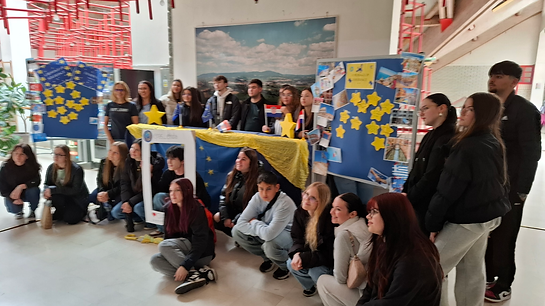


This project aims to address the selected priorities and make a contribution to achieve a few of the European aims highlighting as a priority the "Promotion of groups of people of less favoured areas with less opportunities, aiming the equity and inclusion", encouraging the development in the areas of ICT and digital skills, communication and foreign language skills, intercultural understanding and self-development, as well as the autonomous development of learnings and teaching/learning resources.
Building more inclusive, just and fair societies must start with inclusive education systems. Our goal is to combat social exclusion and discrimination, promote social justice and protection, equality between women and men, and protection of the rights of the child, respect the world's rich cultural and linguistic diversity and contribute to solidarity and mutual respect among peoples by teaching students to value human dignity, equality and human rights using various comprehensive resources on a wide range of topics
relating to inclusive education and UNESCO's Sustainable Development Goal 4 on education.
With this project we intend to address a priority topic of inclusion and diversity in education fostered by active engagement
and participation of each one of us, and tackle issues not only of learning disadvantages, early school leaving or low proficieny, but also taking steps to prevent any forms of exclusion, marginalization and inequality in learning processes. The inclusion of young people we meet regularly in our schools proceeding from "minorities" such as different ethnic backgrounds, youngsters from less favoured areas or with fewer opportunities, to those who feel excluded or isolated, can only occur when the community recognise them and in their turn they have the confidence to show themselves sharing with their peers their differences. To recognize and accept the differences, there is a learning process in two ways, formal and informal learning, inside and outside the classroom. Therefore, the teachers should be aiming at the use of new pedagogic methodologies to achieve the success in inclusive education. The exchange of the students with whom we will work will allow the sharing of their "worlds" with other young people from other communities, developing therefore, social, civic, intercultural skills. This will be a very important contribution to the acceptance of the differences and it will also develop an important role to avoid discrimination, segregation, racism, bullying and violence.
Social Inclusion has been a compelling challenge for the schools and educational system, therefore teachers and educators
need to have new approaches in what concerns learning and educational success.
We intend to achieve the results that are directly linked to the priorities of inclusion and diversity in education, therefore our
objectives are:
- To boost among the involved youngsters the experience of sharing their cultures, the challenges they face for being
different. This will allow them to develop social, civic and intercultural skills.
- To foster the critical thinking and the literacy with the help of new technologies (ICT) developing, thus, the resilience to
discrimination, to violence and to segregation.
- To enable that the different learnings will be real, sustainable and meaningful, motivating them to new academic paths,
contributing, this way, to the reduction of the rates of early school leaving and having the feeling of belonging.
- To raise awareness in the educational community of the involved schools to the addressing issue of "the different" and to
the necessity of raising a pedagogic environment which benefit the sharing, the learning with the other, the cooperative
work, the development of the critical thinking and the use of the new technologies as a privileged mean of access and share
information.